10 years of web performance debate:

“Your site is only faster because it does less”
“Yep”
“It’s not fair to compare them”
“Why?”
“It does fewer things”
“Yeah—to make it faster”
“That’s not fair”
“Why?”
“I want mine to do more”
“Okay—but it will be slower”

I need to issue a correction for an earlier (deleted) toot about Next.js’ <Image> and WebP support.

The default `formats` value is `image/webp` https://nextjs.org/docs/pages/api-reference/components/image#formats

And using the Accept header to fallback to the original format: https://developer.mozilla.org/en-US/docs/Web/HTTP/Content_negotiation/List_of_default_Accept_values#values_for_an_image

With that reading it suggests that a JPEG or PNG source would work fine on Safari (prior to Mac OS Big Sur)—though I doubt a newer format input would work there but that’s a much smaller problem.

Appreciate the pushback @flq!

(disclosure: I am firmly pro-build)

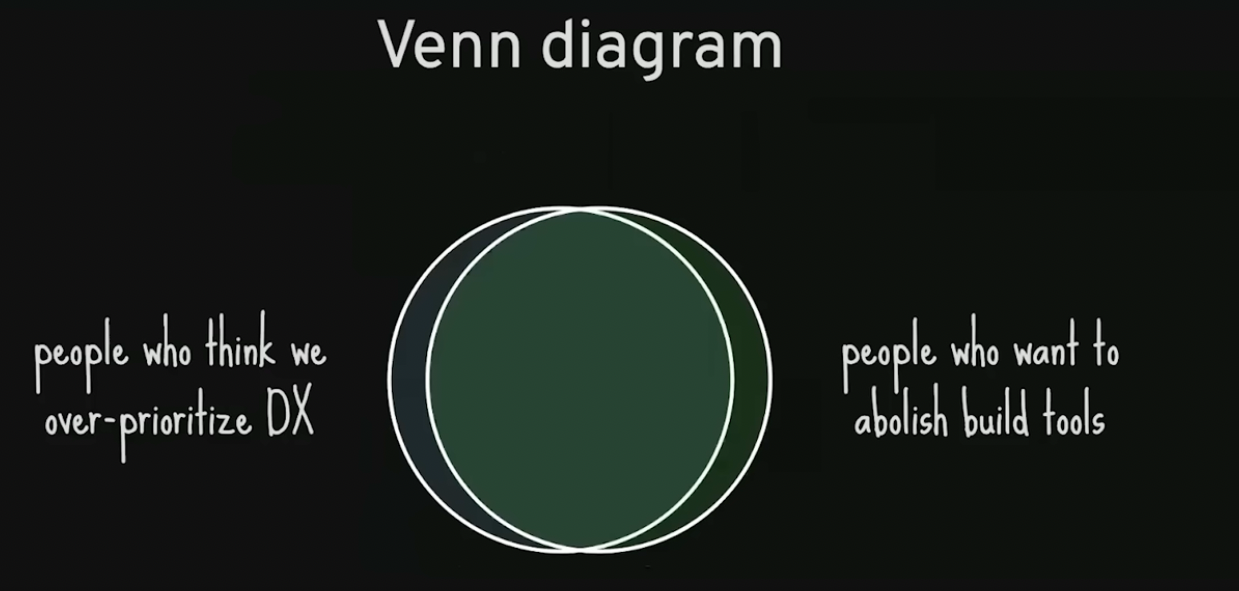
Folks that want to “abolish” build tools are (in my experience) arguing and demanding more from the platform (which I agree with 100%) to go further *without* a build—something that @rich_harris has argued in favor of in the web components discussion. This section of the video felt like a mischaracterization to me.

“Wreak havoc as an irresistible bloatable possum”

“Join forces with a playful friend and increase the chaos in the local co-op”

“Embrace the chaos by screaming when you get chased or giggling when you get away with it”

“Risk it all for one final crumb of food”

now re-read these as taglines for an open source project

If jQuery in the early 2010s had the same paid advocacy that React currently has, we’d likely still be using jQuery for everything.

It’s time for the next era of front end—bring on Svelte, Solid, Marko, Lit, et al.

sometimes I wonder how much money has been spent on the development of react—I wouldn’t be surprised if facebook has spent something in the ballpark of $20-30 million at this point

is that too high? too low? curious what y’all think

Here’s an HTML-only check for Declarative Shadow DOM support that I used in a demo just now:

```
<div>
<p>Declarative Shadow DOM is <strong>⚠️ not supported</strong> in your browser.</p>
<template shadowrootmode="open">
<p>Declarative Shadow DOM <strong>✅ is supported</strong> in your browser.</p>
</template>
</div>
```

Looks like https://www.zachleat.com/web/single-page-applications/ popped off on the orange site, currently holding 113 well reasoned comments—featuring gems like:

💎 “React 16 is about 5 KB uncompressed”
💎 “228 kB of JavaScript? That's a moderately sized image”
💎 “His way to make a website available to any browser is to use an API that nothing but the latest Chrome supports?”
💎 “is SEO important in 2023? how much traffic is coming from Google that converts to paying customers or clients?”

If your name is @kateholterhoff and you’re conversing with certain Next.js framework authors on a twitter thread (that mentions me), this timeline might interest you:

April 2020: `unstable_runtimeJS` merged to Next
https://github.com/vercel/next.js/pull/11949

Sept 2021: “øJS is coming to Next 🔜”
https://twitter.com/rauchg/status/1437494013137805312

Lest history be revised, “øJS is coming soon” was not referencing the already released `unstable_runtimeJS` feature. So what was it referencing (on a thread about islands architecture)? 🫠