Had a great chat with @mikeneu about the Jamstack and what we can do to preserve the usefulness of the term moving forward: https://www.youtube.com/watch?v=BPKIU9Ow_ZU
 Zach Leatherman 7 likes4 reposts Original on Mastodon
A versioned archive of posts from Bluesky, Mastodon, GitHub, npm, YouTube, Letterboxd, Hacker News, and blogs. Browse the most popular posts.
Last built .
| Since | posts | replies | likes | reposts and quotes | views | |
|---|---|---|---|---|---|---|
| Bluesky | 1,039 | 8,236 | 23,127 | 2,380 | ||
| Mastodon | 2,399 | 29,156 | 55,396 | 16,820 | ||
| GitHub | 179 | 5,777 3,520 | 33,866 | 3,317 | ||
| npm | 139 | 1,546 | 75,991,720 | |||
| YouTube | 30 | 1,203 | 32,713 | |||
| Letterboxd | 55 | |||||
| Blog | 20 | |||||
| Hacker News | 59 | 575 | 802 | |||
| All | 4,807 | 37,967 | 114,394 | 22,517 | 76,024,433 |
Had a great chat with @mikeneu about the Jamstack and what we can do to preserve the usefulness of the term moving forward: https://www.youtube.com/watch?v=BPKIU9Ow_ZU
Zach Leatherman 7 likes4 reposts Original on MastodonThe view today 👀

Zach Leatherman 6 replies 57 likes Original on Mastodon“When I […] go to canisue, it seems that all browsers support the inert attribute.”
is canisue new? haven’t heard of that one before
Zach Leatherman 10 replies 18 likes1 repost Original on Mastodona substack alternative named superstack
Zach Leatherman 11 replies 19 likes2 reposts Original on Mastodona short commute to the @cloudcannon office 🇳🇿
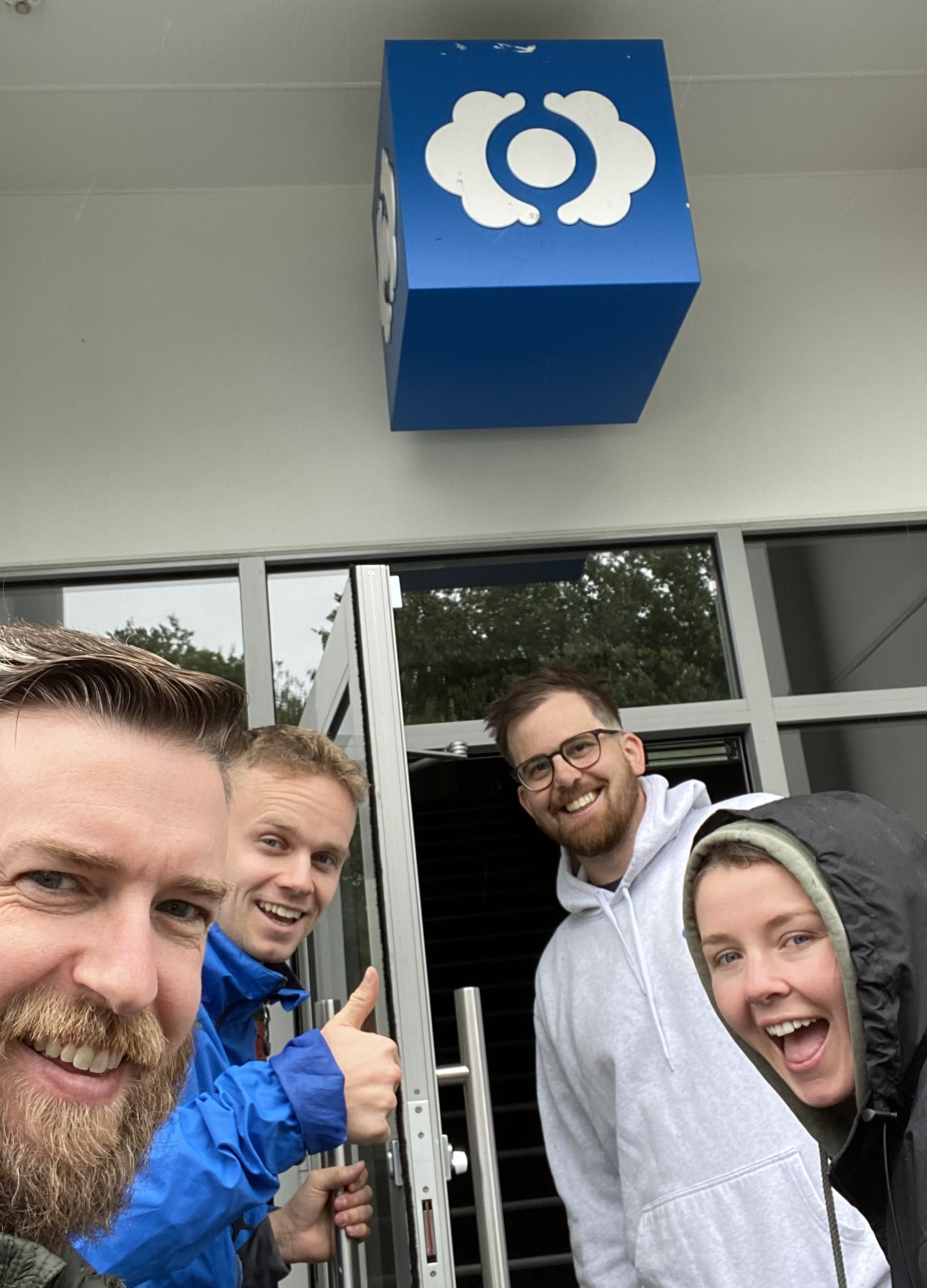
“Bake, Don’t Fry” was almost 22 years ago—and it is still one of the all-time great blog posts.
Zach Leatherman 3 replies 34 likes17 reposts Original on MastodonDo any web browser devtools (Chrome, Firefox, Safari, etc) allow you to inspect an image’s EXIF metadata?
Zach Leatherman 8 replies 4 likes1 repost Original on MastodonJust a regular reminder that https://www.fastmail.com/ is great.
Zach Leatherman 4 replies 38 likes10 reposts Original on MastodonI tested the new microsoft copilot button and I have bad news: it’s actually a copilot <div>
Zach Leatherman 21 replies 81 likes7 reposts Original on MastodonOriginal on BlueskyLooks like Google Fonts placeholder text is pulling excerpts from the UN’s Universal Declaration of Human Rights 👀
https://www.un.org/en/about-us/universal-declaration-of-human-rights

Zach Leatherman 10 replies 26 likes7 reposts Original on Mastodonwhat can web components do for US student loan forgiveness
Zach Leatherman 16 likes1 repost1 comment Original on Mastodonif we are going to have unrealistic expectations for web components—can they do something about the military-industrial complex?
Zach Leatherman 12 replies 25 likes4 reposts Original on Mastodon📮 New on the blog, my 2023 recap post:
“2023 has been one hell-for-leather roller coaster of a year.”
Zach Leatherman 19 replies 46 likes14 reposts Original on MastodonOriginal on BlueskyI’ll be speaking at @cfedev’s TheJam.dev 2024 at the end of January!
Zach Leatherman 13 likes6 reposts Original on MastodonOriginal on Blueskywhich javascript component library best exemplifies zack snyder and why is it react
Zach Leatherman 7 replies 22 likes3 reposts Original on Mastodonfollow me for more very professional content
apropos of nothing my kids have informed me that they think it’s strange that (american) football players spank each other on tv 😂
—first of all how do you even know about spanking 🧐
Zach Leatherman 5 replies 14 likes Original on MastodonI am now certified on LinkedIn

looking for a sustainable way to fund your open source project already relied upon by countless businesses worldwide?
first let me ask you a question: what do you know about onlyfans?
Zach Leatherman 6 replies 38 likes6 reposts Original on Mastodonwhen is 2020 going to end
Zach Leatherman 3 replies 43 likes7 reposts Original on Mastodonhas your content been the victim of AI content scraping? you may be eligible for compensation! contact the law offices of L, L, and M, LLC today
Zach Leatherman 3 replies 14 likes2 reposts Original on Mastodon“this toy needs three and a half F batteries? what is an F battery??”
Zach Leatherman 8 replies 16 likes1 repost Original on Mastodonhappy try-not-to-lose-your-shit-as-you-endure-terrible-instruction-manuals-and-extremely-poor-toy-design day, for those that celebrate
it’s going wonderful over here 😅😅😅
(merry christmas, y’all 🎄)
Zach Leatherman 15 replies 36 likes2 reposts Original on Mastodon*polling scrutiny intensifies*
Zach Leatherman 4 likes Original on MastodonWhich answer (in a poll) is statistically the most popular answer?
Zach Leatherman 8 replies 7 likes2 reposts Original on Mastodonlook, you aren’t *allowed* to add a build step to web components because the specious arguments against web components fall apart if you do that
Zach Leatherman 3 replies 12 likes1 repost Original on MastodonIf folks could refrain from comparing no-build-step Web Components (oranges) to *build-step* Component Frameworks (apples), I would be very happy.
Feel free to compare no-build-step Web Components (oranges) to no-build-step Component Frameworks (oranges) though.
Zach Leatherman 12 replies 28 likes4 reposts Original on Mastodon📮 New on the blog:
Building a multi-language Taylor Swift fan site with @cloudcannon and @eleventy (Zach’s version)
Zach Leatherman 8 replies 15 likes6 reposts Original on Mastodonlaser pointers are a cat’s sisyphus boulder
Zach Leatherman 8 likes1 repost Original on MastodonAlert Alert: We have movement, we have movement!
A fully fledged PR to fix the issue (with a warning instead of an error): https://github.com/nodejs/node/pull/51244
Exciting!
Zach Leatherman 2 replies 6 likes1 repost Original on MastodonAfter over a year of using Mastodon almost exclusively for social media—it’s *still* a shock to go back to visit an algorithmically-driven social network.
Scrolling and reading on other sites feels like eating a candy bar while drinking a soda—the candy bar has very little flavor—your taste buds are already overloaded by sugar.
And yet sugar is the algorithmically incentivized form of content, so sugary posts are the only ones that get traction.
Zach Leatherman 15 replies 47 likes10 reposts Original on Mastodondon’t boost the above toot, please boost the original toot instead—or boost both if you’re super cool (and thank you):
It’s @lynnandtonic day!! (for those that celebrate)
(but if you don’t celebrate—that’s on you)
Zach Leatherman 5 replies 15 likes6 reposts Original on Mastodon*sweating profusely*
I have advocated for myself
*still sweating*
…when do the good feelings about it start
Zach Leatherman 16 replies 40 likes6 reposts Original on Mastodon@hexagoncircle Ryan are you sure you want to boost that post??
📮 New on the blog:
Netlify’s Disingenuous Survey-based Attack on Next.js (and Eleventy, too)
Zach Leatherman 37 replies 70 likes50 reposts Original on MastodonOriginal on Bluesky@pupismyname howdy John! I sent you a DM on LinkedIn but I guess you don’t go there much 😅
according to their pricing page $20B gets you about 12 million years on the enterprise plan, for the record
Zach Leatherman 11 replies 13 likes1 repost Original on MastodonBreaking news: I have also decided not to buy Figma for $20B today
Zach Leatherman 34 replies 123 likes15 reposts1 quote Original on MastodonOriginal on BlueskyIf you want to try out the new Eleventy v3 alpha releases, read this:
Zach Leatherman 7 likes4 reposts Original on MastodonAm I done with this thread? Apparently not. 😅
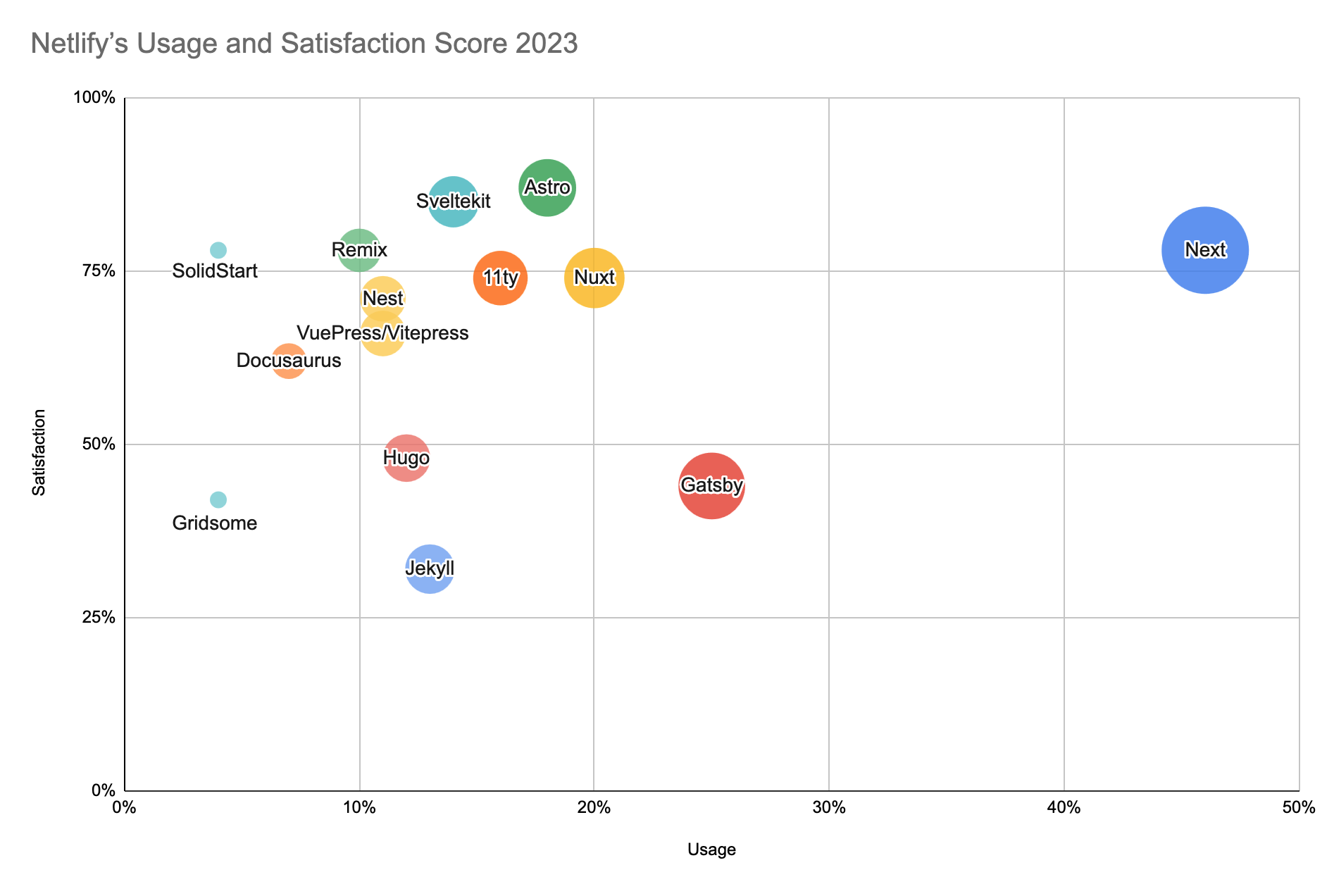
Here’s what an intellectually honest version of the Netlify State of the Web chart looks like (and this one doesn’t obscure Gatsby)
Zach Leatherman 8 replies 23 likes10 reposts Original on Mastodon@zachleat One more thought before I sign off: I’m very interested to read the (afaict) absent methodology document that was historically included alongside the survey, documenting sources of data and margins of error.
Here’s the one from 2022: https://jamstack.org/survey/2022/community-survey-2022-methodology.pdf
I’m sure it will arrive shortly!
Zach Leatherman 9 replies 11 likes Original on Mastodon(and I hope Astro dethrones Next.js too)
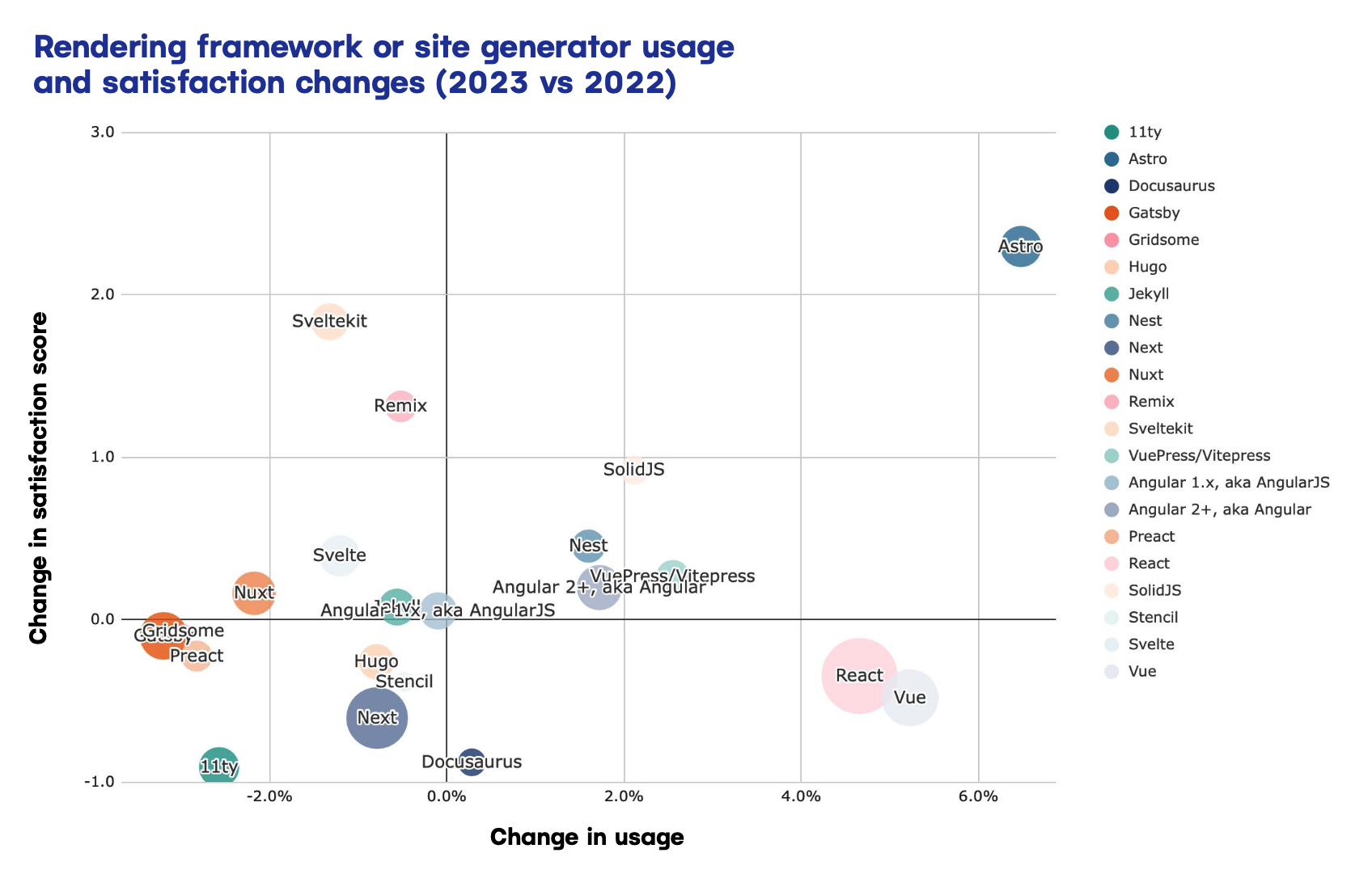
Zach Leatherman 13 replies 23 likes1 repost Original on MastodonImportantly: Eleventy is *still* punching far above its weight despite the Netlify-induced setbacks we faced this year.
Many of the frameworks listed are VC-funded with multiple full-time developers. We don’t have that—intentionally. Our project goals are different.
As I’ve said before: Eleventy and Astro are allies in the web development framework melee. When Astro wins, Eleventy wins too. It isn’t a zero-sum game.
Zach Leatherman 22 replies 51 likes7 reposts Original on MastodonThis chart has the absolute numbers (conveniently unordered, though 😬)
Next.js is tied for positive/negative sentiment ratings at #3 with SolidStart and Remix.
Eleventy is tied for #6 overall (alongside Nuxt).
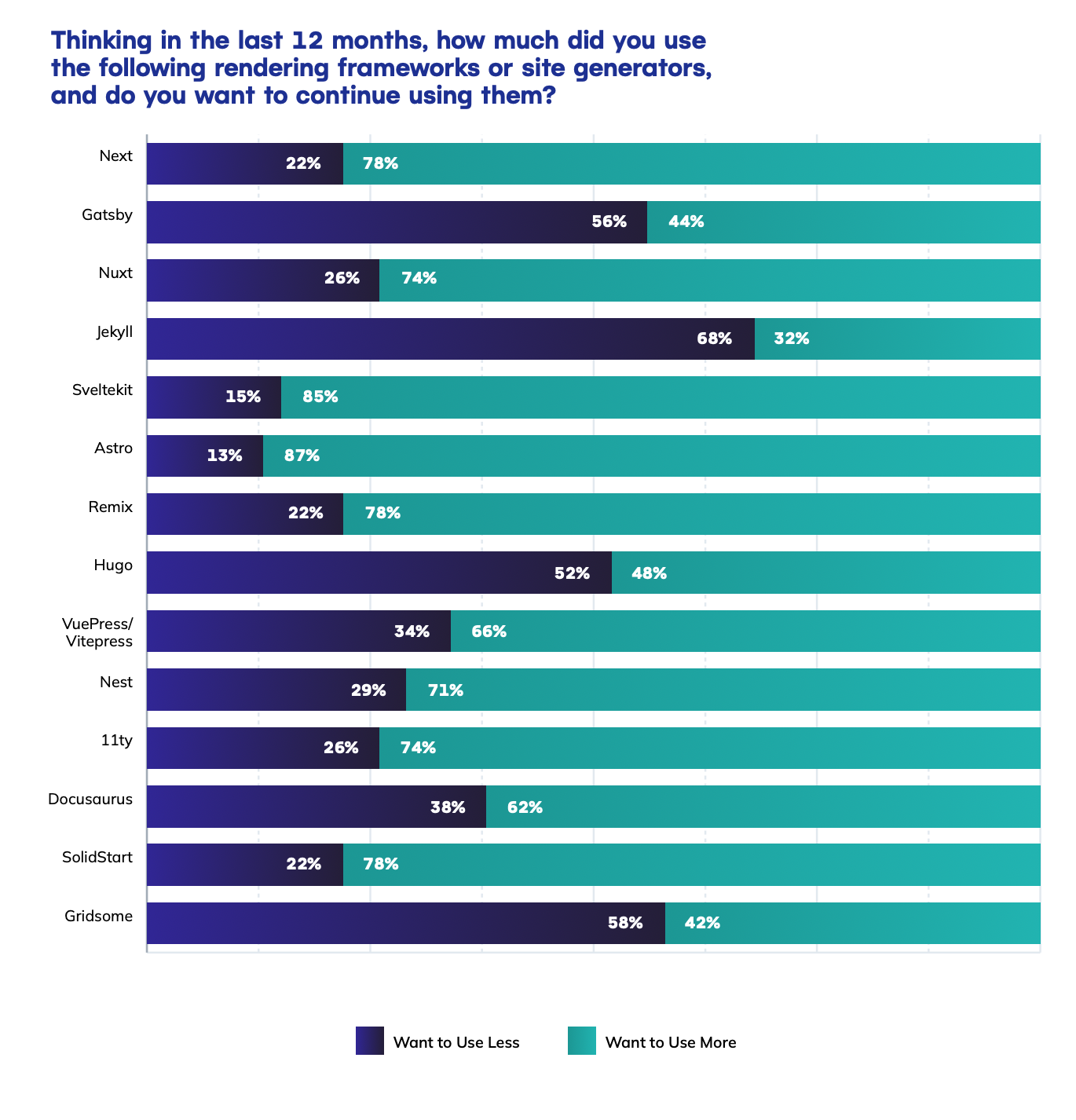
Zach Leatherman 24 replies 14 likes6 reposts Original on MastodonAlright, this graph from Netlify’s “State of the Web” survey is… intellectually dishonest. And I have to weigh in on it now because a few folks have been making some *specious* assumptions and tagging me 😬
I get it: Netlify wants to highlight graphs that make Next.js look bad but c’mon—leave me out of it.
(I also understand that their resident statistics person departed the company so… it’s unlikely that this was malicious)
🧵🔽
Zach Leatherman 29 replies 24 likes9 reposts Original on Mastodonhttps://www.11ty.dev/ is now built with Eleventy v3 *exclusively* using ESM (no CommonJS)
View the final PR https://github.com/11ty/11ty-website/pull/1636
(Please let me know if you see anything… weird 😅)
Zach Leatherman 8 replies 38 likes7 reposts Original on MastodonWhile zachleat.com was a CJS to CJS migration, I’m currently updating 11ty.dev to be Eleventy v3 using ESM.
That work is in progress here:
https://github.com/11ty/11ty-website/pull/1636
Live demo:
https://eleventy-v3--11ty.netlify.app/
Zach Leatherman 11 replies 15 likes3 reposts Original on Mastodonzachleat.com is now building using the very first alpha release of @eleventy v3.0:
You can see my upgrade PR below. It was—well—a pretty straightforward upgrade:
Zach Leatherman 34 replies 54 likes14 reposts Original on MastodonOriginal on BlueskyTickled to see so many folks adding this—y’all make building for the web fun! ❤️
A few folks have already added this to their web site! 🏆
1️⃣ @simoncox’s http://www.simoncox.com/
2️⃣ @bw’s https://bw.omg.lol/
3️⃣ @jhofker’s https://jordan.hofker.org/
4️⃣ https://ndyg.omg.lol/
Quick work!
Zach Leatherman 7 replies 6 likes1 repost Original on Mastodon Zach Leatherman 59 replies 65 likes36 reposts Original on MastodonOriginal on BlueskyLooks like Vite writes a temporary file to the file system to work around this issue 👀 https://github.com/vitejs/vite/blob/77d5165e2f252bfecbb0eebccc6f04dc8be0c5ba/packages/vite/src/node/config.ts#L1172-L1184
The bare minimum you can do is to post a methodology document to show each individual question on the survey, how the survey was compiled, sources of data, etc. If we’re not doing that, it’s noise.
If a “survey” displays results from questions about developer perception of frameworks without filtering out folks that have never used the framework, it ain’t much use—is it?
Are we interested in Amazon reviews from people that have never bought the product? Or movie reviews from people that haven’t watched the movie?
It’s frustrating out here, y’all.
Zach Leatherman 5 replies 15 likes1 repost Original on MastodonI see this experimental limbo for Node.js’ ESM `vm.Module` causing large scale problems elsewhere too, right?
Jest seems to be trying to stick to Node.js APIs (which is a good goal!) and people are migrating to Vitest for “stable” ESM support—but Vitest is using `esbuild` to sidestep the experimental status.
Filed a Node.js issue as a last resort 😭. If CommonJS supports `import()`, why doesn’t `vm` support `import()`?
https://github.com/nodejs/node/issues/51154
Or, I’d love a stable `vm.Module`! Or Node.js ShadowRealms! I shouldn’t have to use a bundler for this stuff.
Here’s how I think about it and I think this is the only way to survive as an indie open source project in a VC-funded world:
The #1 competitor to Eleventy will always be the previous version of Eleventy.
Zach Leatherman 3 replies 39 likes2 reposts Original on Mastodonoh hi

Zach Leatherman 11 replies 34 likes2 reposts Original on Mastodonorganizations extremely concerned with the scalability of CSS need to put that same energy into the scalability of JS
Zach Leatherman 11 replies 35 likes18 reposts Original on Mastodon📮 One YouTube Embed weighs almost 1.2 MB
Zach Leatherman 22 replies 61 likes40 reposts Original on MastodonOriginal on Blueskyhow are those 3D televisions holding up
Zach Leatherman 11 replies 12 likes1 repost Original on MastodonI have redesigned my web site one thousand times, one small component at a time
Zach Leatherman 3 replies 19 likes1 repost Original on Mastodonthese amateur ornithologists can’t stop looking at tweets on the bird site

Zach Leatherman 1 reply 42 likes7 reposts Original on MastodonFixed what I think may have been the gnarliest @eleventy bug yet: a mixture of multiple subtle things when using pagination, computed data, and (internally) data mutability in proxies on the data cascade.
I learned a few things and left everything cleaner than it used to be but I’m going to rest now 🧠😴
Zach Leatherman 3 replies 31 likes Original on MastodonLet the ad blockers block ads.
Zach Leatherman 6 replies 22 likes3 reposts Original on Mastodonis it *really* too much to ask for every single person to keep their content available online, in perpetuity, for all time and forevermore?? c’mon, y’all
Zach Leatherman 16 replies 49 likes9 reposts Original on Mastodon Zach Leatherman 10 replies 27 likes18 reposts Original on MastodonOriginal on Blueskymaking an open source project starts out like you’re having fun playing at the local neighborhood sandlot and suddenly the $7.1B new york yankees show up for a game
Zach Leatherman 3 replies 32 likes2 reposts Original on Mastodontesla could never make a cybervan and we all know why
look—no, you started drinking eggnog too early
my toxic trait is that I don’t trust people that hate minivans
Zach Leatherman 12 replies 20 likes1 repost Original on MastodonI kinda wanted folks to answer about their desktop/laptop experience but didn’t specify, unfortunately!
`mailto:` links:
Zach Leatherman 15 replies 2 likes1 repost Original on Mastodonnew web component goofin’
Zach Leatherman 3 replies 14 likes1 repost Original on MastodonI am loving the View Transitions demos but (imo) it seems risky to build framework level integrations for the feature before there are two browser implementations in the wild.
Zach Leatherman 1 reply 28 likes6 reposts Original on MastodonI don’t know if any single image could be a better metaphor for modern web development:
Zach Leatherman 6 replies 65 likes27 reposts Original on MastodonCongrats to the @astro team on the v4 release!
Love the little development toolbar—it looks awesome 👀
Zach Leatherman 1 reply 16 likes Original on Mastodonwhat is a large language model if not three small language models in a trench coat
Zach Leatherman 8 replies 38 likes12 reposts Original on MastodonPrevious in this series: https://www.zachleat.com/twitter/1584995586918731776/
Vercel’s Next.js v14 has shipped and (as one does) I had a look at the JavaScript footprint of the production build of Hello World:
v14 (2023): 299 kB
v13 (2022): 272 kB
v12 (2021): 228 kB
Unfortunately the same trend continues, even with a new bundler: the bundles are growing!
(and with Tailwind included by default, too)

Zach Leatherman 22 replies 61 likes45 reposts Original on MastodonCan I (should I?) use @1password to log in to a secondary 1Password account?
We’re discussing the future of the Jamstack:
https://thefutureofjamstack.org/
Join us!
(as seen in the announcement banner on jamstack.org! 👀)
Zach Leatherman 8 likes8 reposts Original on Mastodonscrolling on mastodon, increasingly flabbergasted by how much this one individual has shared—had to be almost 30 contiguous posts on my timeline!
…until I realized I was on their profile page
Zach Leatherman 6 replies 39 likes Original on Mastodon@chriscoyier trying to make Eleventy’s IndieWeb Avatar service work for Codepen and I figured it might just be easier to ask, the fetch to http://codepen.io/favicon.ico returns 503 Forbidden (looks like some Cloudflare security stuff)—is it possible to add an exemption on your end for the icon?
a few minutes after we put a christmas tree up

Zach Leatherman 9 replies 96 likes12 reposts Original on MastodonI hit 400 posts on the blog this week!
🗓️ 17 years (2007+)
🔭 3.5M Page views
🔩 WordPress to Jekyll to Eleventy
Blogging changed my life, big time.
Zach Leatherman 11 replies 67 likes11 reposts Original on Mastodoncompany with high employee turnover, ship of theseus thought experiment
1. how it started
2. how it’s going


Zach Leatherman 10 replies 14 likes1 repost Original on MastodonI’ve started following the hashtag #WebComponents on here so if y’all could tag your posts with it, that would be swell
(I know I haven’t—but I will do my best moving forward)
Zach Leatherman 4 replies 21 likes4 reposts Original on Mastodonhas @aerotwist fixed their web site after it was compromised?
Zach Leatherman 11 replies 32 likes18 reposts Original on MastodonOriginal on Bluesky🔗 Why We’re Dropping Basecamp
https://blogs.library.duke.edu/blog/2023/11/30/why-were-dropping-basecamp/
“We came to this decision after weighing the level of its use in our organization, which is considerable, against the harms that we see perpetuated by the leadership of Basecamp’s parent company, 37signals.”
Zach Leatherman 5 replies 35 likes18 reposts Original on Mastodonwhere are all of the snow web components
not you, @cloudfour—I’m already meticulously watching all of your excellent work
Zach Leatherman 60 replies 19 likes18 reposts Original on Mastodon🎥 New video:
Live Editing on an @eleventy Web Site in @cloudcannon
https://www.youtube.com/watch?v=AsWt6BTjzyk
My favorite part of this demo is showing live updates on the <browser-window> web component 👀 (~1 minute in)
Zach Leatherman 3 replies 12 likes8 reposts Original on MastodonOriginal on BlueskyAs a thought experiment, how would the JavaScript ecosystem replicate this redirect to a random post feature?
https://chriscoyier.net/2023/11/29/a-random-route-on-a-wordpress-site/
And just for fun, let’s brainstorm things that *aren’t* single-host features like Netlify redirects.
Looks like @morganm@subdued.social showed what you’re supposed to do in this situation and filed an issue:
https://github.com/bigskysoftware/htmx/issues/2055
Thank you!
And I guess I can’t wear this shirt any more https://www.zachleat.com/twitter/1096922195044036609
Zach Leatherman 5 likes1 repost Original on MastodonLook ma, I made a web component
https://zachleat.github.io/w3c-banners/
Web components are fun and I’m having fun.
(Originally from 2014:
https://www.zachleat.com/web/w3c-status-banners/)
Zach Leatherman 5 replies 17 likes2 reposts Original on MastodonI didn’t have time to record a short video, so I recorded a long one.
Zach Leatherman 23 likes3 reposts Original on Mastodonhttps://htmx.org/ needs a doctype 😬
Zach Leatherman 10 replies 14 likes4 reposts Original on Mastodon