Today, the good people of the world commemorate the passing of Google Reader eleven short years ago on July 1, 2013.

To honor their memory (and in leiu of flowers) please add an RSS, Atom, JSON or equivalent feed to your web site and keep building towards a web that connects people in meaningful and positive ways.

The other lesson here is in the real consequences of maintainers (even those with a small following) airing small dev grievances on Twitter (Svelte/SvelteKit in this case).

The parasitically harmful YouTube JavaScript influencer ecosystem feeds on small drama like this, resulting in elevated abuse toward well-intentioned maintainers—pretty gross all around.

One lesson I’m taking away from the axobject-query incident: there isn’t a formal agreement about which npm packages are isomorphic JavaScript friendly (intended for both client & server).

Notably the `browser` key in package.json is documented as to be used *instead* of `main` (not both): https://docs.npmjs.com/cli/v10/configuring-npm/package-json#browser (and axobject-query does not use `browser`)

Assuming that packages are client bundle friendly without tacit agreement from the maintainers of those packages is perilous!

The vast official Windows terminal application landscape unfortunately complicates basic tasks.

Want to educate folks on the basic command used to create a file on the command line? The instructions are different for Command Prompt, Terminal/Windows PowerShell, and PowerShell Core.

POSIX and PowerShell Core:
echo "# Header" > index.md

Command Prompt (no quotes):
echo # Header > index.md

Windows PowerShell (`>` defaults to UTF16):
echo "# Header" | out-file -encoding utf8 "index.md"

One of the lowest low hanging fruits I see browsing the web today is layout shift when an obtrusive scrollbar toggles on/off.

It happens when navigating between pages of varying length. It happens with poorly implemented menus/modals/dialogs that toggle `overflow: hidden`. It can happen when a particularly heavy/long page progressively renders.

`html { overflow-y: scroll; }` can fix it for some of these cases.

But primarily: test for obtrusive scrollbars, please!

Thinking about 🔢 Defcon levels of software consent patterns:

1️⃣ Defcon 1: Opt-in without asking (new default), opt-out not allowed.
2️⃣ Defcon 2: Opt-in without asking, opt-out allowed via user action
3️⃣ Defcon 3: Ask for opt-in via prompt with default yes already selected
4️⃣ Defcon 4: Opt-in via non-default user action (manual installation)
5️⃣ Defcon 5: Thing not added, requiring no action by anyone 😅

google.com search results (on a desktop web browser) have a horizontal scrollbar < 1162px viewport width and don’t use responsive design.

Sometimes the biggest web properties in the world make decisions with a completely different set of priorities, goals, budget (etc.) and those decisions wouldn’t make sense to apply to your project (with your own goals, team, and tech stack).

Their best practices are not your best practices!

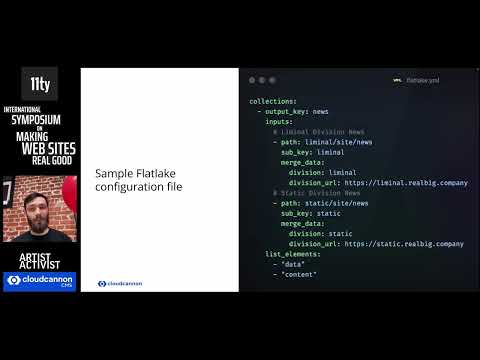
Managing content management (with no vendor lock-in) — David Large, Liam Bigelow (11ty Conf 2024)

Watch Managing content management (with no vendor lock-in) — David Large, Liam Bigelow (11ty Conf 2024) on YouTube

CloudCannon is the Recommended CMS Partner of 11ty:

https://cloudcannon.com/11tyconf/
https://cloudcannon.com/blog/how-to-manage-hundreds-of-connected-websites-with-a-git-based-headless-cms/

This was a talk given at the 11ty International Symposium on Making Web Sites Real Good (2024): https://conf.11ty.dev/2024/managing-content-management/

If Jamstack has taught us anything, it’s that websites work best when they’re generated from folders full of flat files. Even massively interconnected websites!

We talk through a classically Jamstacky approach to content management for large organizations: mounting shared layout and component repositories, creating a central content lake to aggregate content like news articles, and automating site builds and deployments when your content or dependencies change.

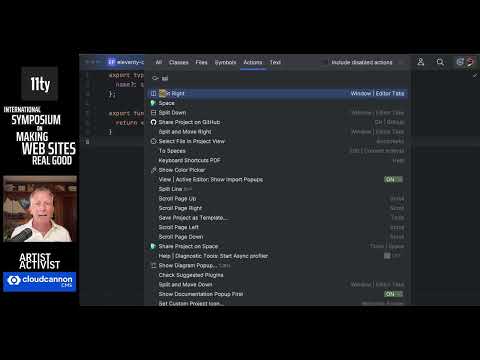
11ty and Large-Project Tooling — Paul Everitt (11ty Conf 2024)

Watch 11ty and Large-Project Tooling — Paul Everitt (11ty Conf 2024) on YouTube

This was a talk given at the 11ty International Symposium on Making Web Sites Real Good (2024): https://conf.11ty.dev/2024/11ty-and-large-project-tooling/

JetBrains has a knowledge base with lots of content, customizing, authors, developers… so we built it in Gatsby. Then switched to 11ty. But we wanted to keep some of the large-project tooling, so we added it. In this talk, we'll cover component driven development through TypeScript and TSX, unit testing with Vitest, in-editor validation of Markdown frontmatter for authors, content queries, and more.

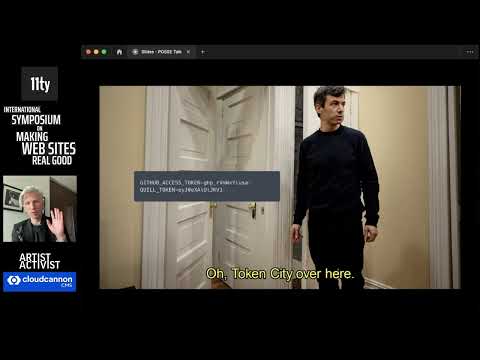
Digital Frontiers, IndieWeb Cowboys, and A Place Online To Call… — Henry Desroches (11ty Conf 2024)

Watch Digital Frontiers, IndieWeb Cowboys, and A Place Online To Call… — Henry Desroches (11ty Conf 2024) on YouTube

This was a talk given at the 11ty International Symposium on Making Web Sites Real Good (2024): https://conf.11ty.dev/2024/digital-frontiers-indieweb-cowboys-and-a-place-online-to-call-your-own/

The IndieWeb is a community of developers and designers and web-surfing wraiths connected by a belief in personal websites/domains as identity, digital self-publishing, and perhaps most chiefly owning one's content. In this talk, Henry will explore the key principles of the IndieWeb, and specifically focus on the concept of POSSE (or "Publish (on your) Own Site, Syndicate Elsewhere"), its benefits, and how it empowers folks to reclaim ownership of their online content or data. They will also discuss concrete and actionable strategies for implementing POSSE in one's own online presence (PERHAPS USING ELEVENTY?!?!?) and the potential impact it can have on the wider web

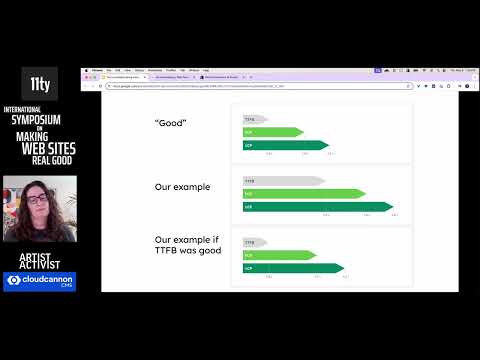
You're Probably Doing Web Performance Wrong —  Sia Karamalegos (11ty Conf 2024)

Watch You're Probably Doing Web Performance Wrong —  Sia Karamalegos (11ty Conf 2024) on YouTube

This was a talk given at the 11ty International Symposium on Making Web Sites Real Good (2024): https://conf.11ty.dev/2024/you-re-probably-doing-web-performance-wrong/

Lighthouse 100 is a common goal for developers seeking to make their sites fast, but does this really center user experience? In this talk, Sia will cover how to get a broader perspective on how real users are experiencing your website performance and better strategies for improving it.

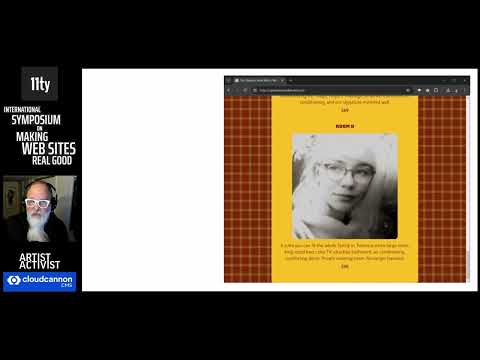
Building a Town That Doesn't Exist — Dan Sinker (11ty Conf 2024)

Watch Building a Town That Doesn't Exist — Dan Sinker (11ty Conf 2024) on YouTube

This was a talk given at the 11ty International Symposium on Making Web Sites Real Good (2024): https://conf.11ty.dev/2024/building-a-town-that-doesnt-exist/

The town of Question Mark, Ohio has a city hall, a newspaper, a library, a chicken joint, an ice cream store, a dump, a haunted factory, two cults, a sordid past, and a mysterious glowing void in the woods.

None of it is real, of course, but all of it exists on the web, thanks to Eleventy, Tailwind CSS, and Alpine.js, the crucial building blocks for creating a year-long immersive novel told not in a book but across the entire internet. This talk looks under the hood at how one person built 40 websites to tell the story of Question Mark, Ohio, a town that disappears into time.

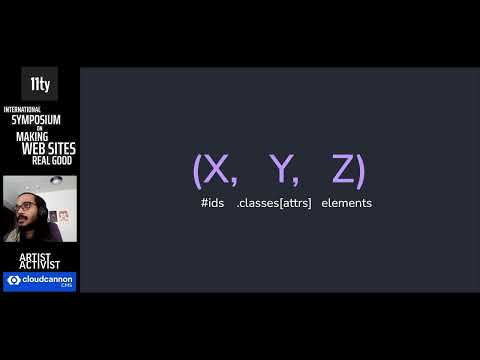
Don't Fear the Cascade — Mayank (11ty Conf 2024)

Watch Don't Fear the Cascade — Mayank (11ty Conf 2024) on YouTube

This was a talk given at the 11ty International Symposium on Making Web Sites Real Good (2024): https://conf.11ty.dev/2024/dont-fear-the-cascade/

In this talk, Mayank will teach the audience how to make sense of the cascade, clear up some common misconceptions (e.g. shadow DOM vs host context styles), and ultimately offer practical advice on how to make best use of the cascade.

They will show off some newer game-changing CSS features (like :where, cascade layers, and @scope) that enable us to write styles with confidence and intention. They may also sprinkle in some tips on how these new features interact with current workflows, including frameworks, build tools, browser devtools, and IDEs.

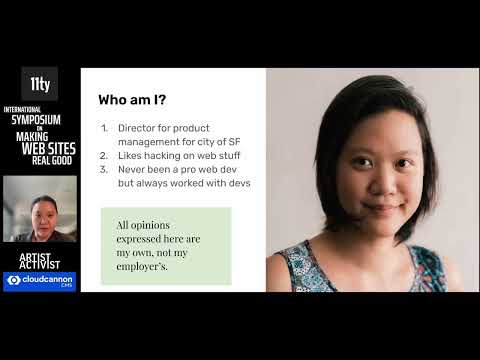
11ty for “Non-Developers” — Adrianna Tan (11ty Conf 2024)

Watch 11ty for “Non-Developers” — Adrianna Tan (11ty Conf 2024) on YouTube

This was a talk given at the 11ty International Symposium on Making Web Sites Real Good (2024): https://conf.11ty.dev/2024/11ty-sites-for-people-who-dont-think-they-are-web-developers/

For a long time, we've thought of web development in two separate streams. WYSWYG builders for non-techical people, code for the rest. What if 'non-technical' isn't real, ‘web dev’ doesn't have to be just something you do for money, and building sites on the open web can be a fun hobby, especially with 11ty?

In this talk, Adrianna will share how 11ty helped them finally break down the ’I’m not a web developer’ thoughts so they could build cool sites. Just like everyone can draw without being an artist, everyone can cook without being a chef.

Adrianna will also share a framework they've developed for talking about and teaching 11ty to people who think they are not web developers, but who really have things to share on the web.

Come to the light side: HTML Web Components — Chris Ferdinandi (11ty Conf 2024)

Watch Come to the light side: HTML Web Components — Chris Ferdinandi (11ty Conf 2024) on YouTube

This was a talk given at the 11ty International Symposium on Making Web Sites Real Good (2024): https://conf.11ty.dev/2024/come-to-the-light-side-html-web-components/

While Web Components have been around for years, they're seeing a bit of a renaissance thanks to an emerging approach for authoring them: ditch the shadow DOM and progressively enhance existing HTML.

In this talk, we'll look at what Web Components, how the "HTML Web Component" approach works, why it's awesome, and some tips, tricks, and gotchas when working with them.

Chinese Type Systems — ivan zhao (11ty Conf 2024)

Watch Chinese Type Systems — ivan zhao (11ty Conf 2024) on YouTube

This was a talk given at the 11ty International Symposium on Making Web Sites Real Good (2024): https://conf.11ty.dev/2024/chinese-type-systems/

In this talk, ivan will educate listeners about understanding Chinese type systems, pairing Chinese fonts, and why its so hard to put your Chinese font in the @font-face in CSS. Typesetting on the web with Chinese fonts is extremely difficult and ivan will give examples of pages that do this beautifully, and recommendations on how to find these.

They will also talk about the history of the Chinese language, the differences in character based vs glyph based, and the difficulties of pairing the two types together. They’ll dive into the various classifications of systems that they use and talk about how to notice and pair Chinese fonts together, as well as actionably implementing them in CSS and the bundle size of the file.